
RITUAL BATHING OF THE DECEASED
Ghusl of the Deceased means washing the body of the dead person. Although the Islamic Society of Greater Salt Lake has appointed personnel to bathe the deceased, it is recommended, Islamically, that an adult male should be bathed by his father, son or brothers. Similarly, an adult female should be bathed by her mother, daughter or sister.
If none of these persons are available then any close relative should carry out, (male for male, and female for female). The person performing the Ghusl must themselves be in ritual purity and in a state of Wudu (ablution). it is makrooh-(disliked) for a woman who is in her menstrual cycle or in a state of post-birth bleeding to perform Ghusl. Once Ghusl is complete, the kafn (shrouding) of the deceased will be carried out.
Note: After performing the Ghusl for the Mayyit (deceased), one does not Islamically need to take a Ghusl/shower. Wudu would suffice, unless there are major impurities on one's body.
SHROUDING
For Male:
First, spread the Lifafah (long sheet), then Izaar (sheet for the lower part of the (body), then the Qamees (sheet to cover chest) that will be under the body. The portion that will cover the top of the body should be folded and put at the side of the head.
Lower the body gently onto the Kafn and cover the top of the body up to the calves with the folded portion of the Qamees. Remove any material used for covering the Awrah/Satr (private area) during Ghusl.
Rub perfume on the head and beard. Then rub camphor mixture paste on the places of SAJDAH (i.e., those parts of the body that touch the ground in salah: forehead, nose, both the palms and the fore feet).
First, fold the left flap, and on it the right flap of the /zaar over the Qamees. Thereafter, fold the Lifafah in the same manner. Remember that the right flap must always be on the top. Lastly, fasten the ends of the Lifafah at the head, feet and around the middle with strips of cloth.
For Female:
First, spread the Lifafah (long sheet to cover the entire body), then the Sinaband (sheet to cover the chest), the Izaar (sheet to cover legs), and then the Qamees (sheet to cover the middle portion of the body) in the same manner stated for males. The Sinaband may also be placed between the Izaar and Qamees or over the Lifafah.
Lower the body gently onto the Kafn and cover the top of the body up to the calves with the folded portion of the Qamees. Remove any material used for covering the Satr during Ghusl.
Do not use perfumes, surmah, kohl or any other makeup. Rub camphor mixture onto the places of Sajdah, i.e., the forehead, nose, both palms, knees and the fore feet.
The hair should be divided into two parts and put onto the right and left breasts. Cover the head and hair with the long scarf. Do not fasten or fold it. Fold the Izaar, the left flap first, and then the right over the Qamees and Scarf.
Now close the Sinaband (breast cover) over these in the same manner.
Close the Lifafah, the left flap first, and then the right.
Lastly, fasten the end of the Lifafah at the head, feet, and around the middle with strips of cloth, to keep the complete Kafn in place.
PROHIBITED ARTICLES IN THE KAFN
It is prohibited to enclose any charter or any Duaa in the Kafn. It is also forbidden to write the Kalimah or any other Duaa on the Kafn or on the chest of the deceased with camphor, ink etc. Do not put any pictures or personal items in the kafn.
FUNERAL PRAYERS
The completion of the Ghusl and Kafn, the Mayyit (deceased person) is ready for the funeral prayer.
The Funeral Salah is Fard Kifaayah (communal obligation)— this means that if a few people in the community perform the act, the entire community is absolved of it.
The funeral prayer consists of four Takbeeraat (saying Allahu Akbar), Thana (glorification of Allah), Durood (salutations upon the Prophet), a Masnoon Dua (prophetic supplication) for the deceased, and two Salam (supplication of peace concluding the prayer). All these are said silently by both the Imam (one leading the (service) and the Muqtadis (congregation of worshippers). It is only the Imam who should call out Takbeeraat and Salaam aloud.
There are two Fard (mandatory) acts in the funeral prayer:
To stand and perform the Prayers.
To recite all four Takbeeraat.
The Masnoon manner (Prophetic way) of performing the Funeral Prayer:
The body of the Mayyit should be placed with the head on the right side of the Imam, who will face the Qiblah.
The Iman should stand in line with the chest of the deceased while performing the prayers. If there are multiple funerals, then the deceased males should be closer to the Imam following females and children.
After the saffs (rows) are straightened, the Niyyah (intention) should be made. The niyyah should be made thus: “I am performing this funeral prayer for Allah behind this Imam (the prayers being a dua for the deceased).
After the niyyah, the hands should be raised up to the ears. The Imam should say Allahu Akbar loudly and the worshippers in the congregation, softly. Then, fold the hands similar to all daily prayers.
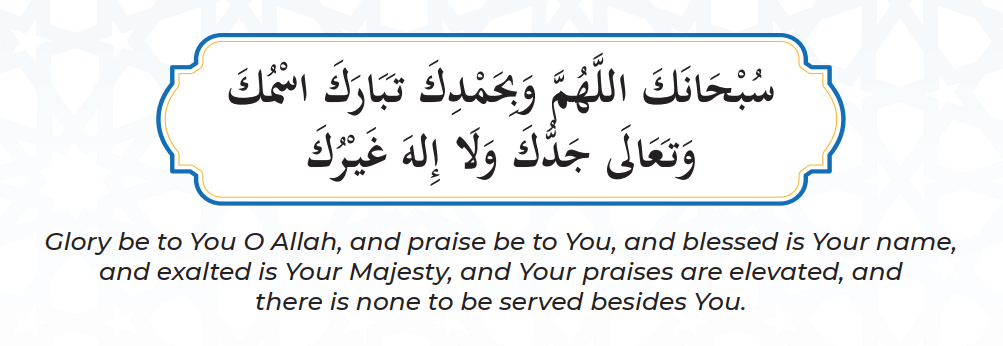
Recite Thana softly or Surah Al-Fatiha:
THANA
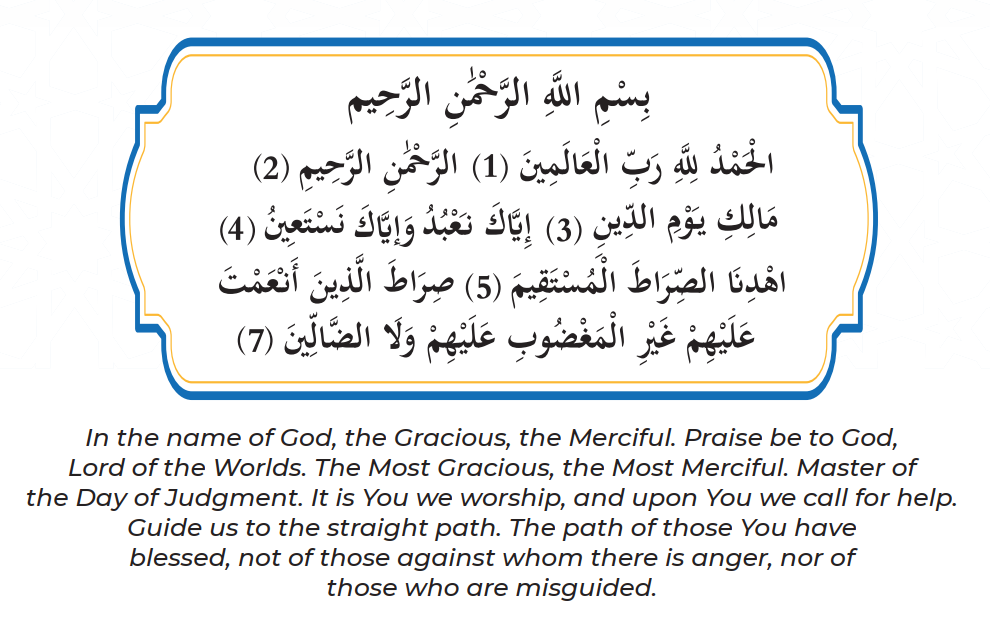
SURAT AL FATIHA
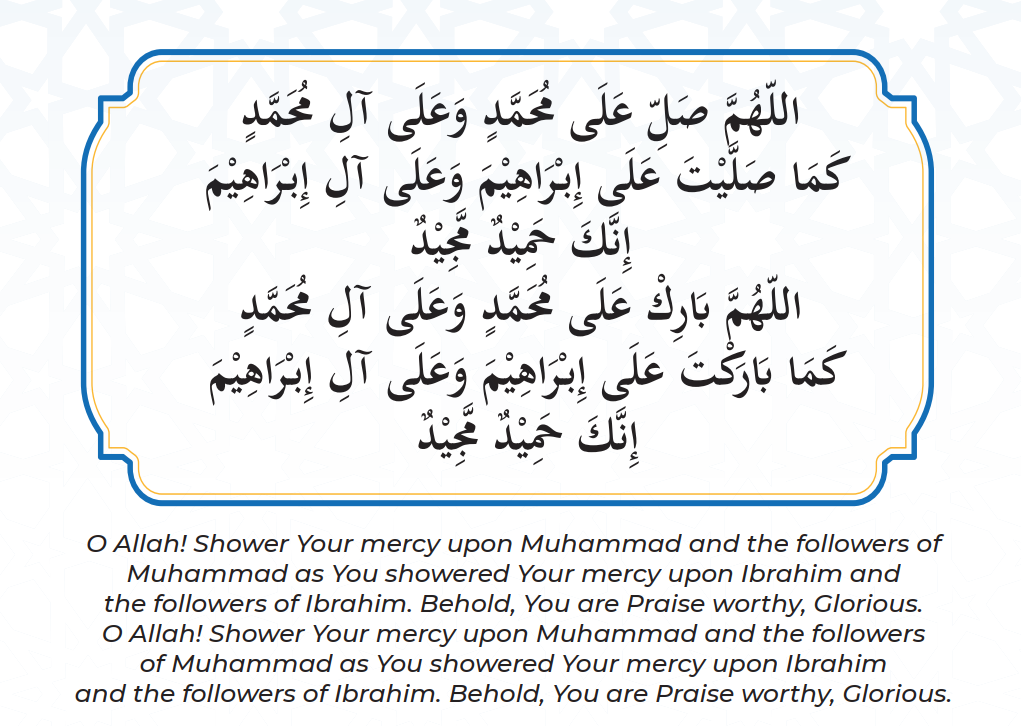
DROOD IBRAHIM
O Allah! Shower Your mercy upon Muhammad and the followers of Muhammad as You showered Your mercy upon Ibrahim and the followers of Ibrahim. Behold, You are Praise worthy, Glorious. O Allah! Shower Your mercy upon Muhammad and the followers of Muhammad as You showered Your mercy upon Ibrahim and the followers of Ibrahim. Behold, You are Praise worthy, Glorious.
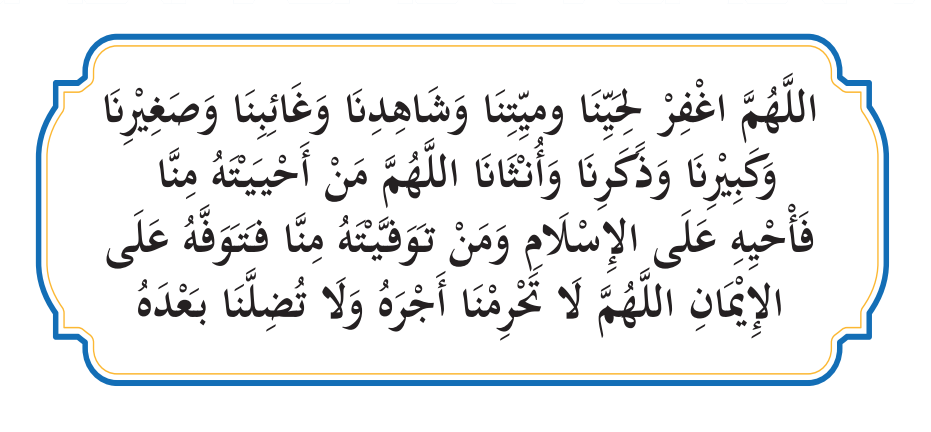
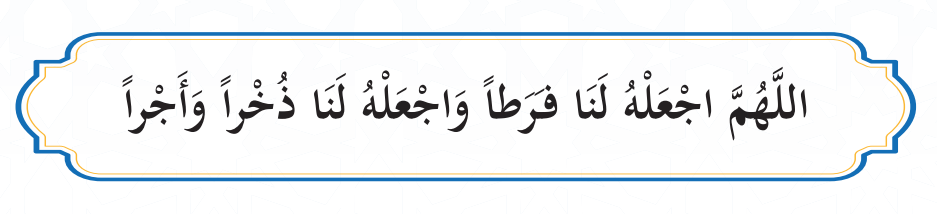
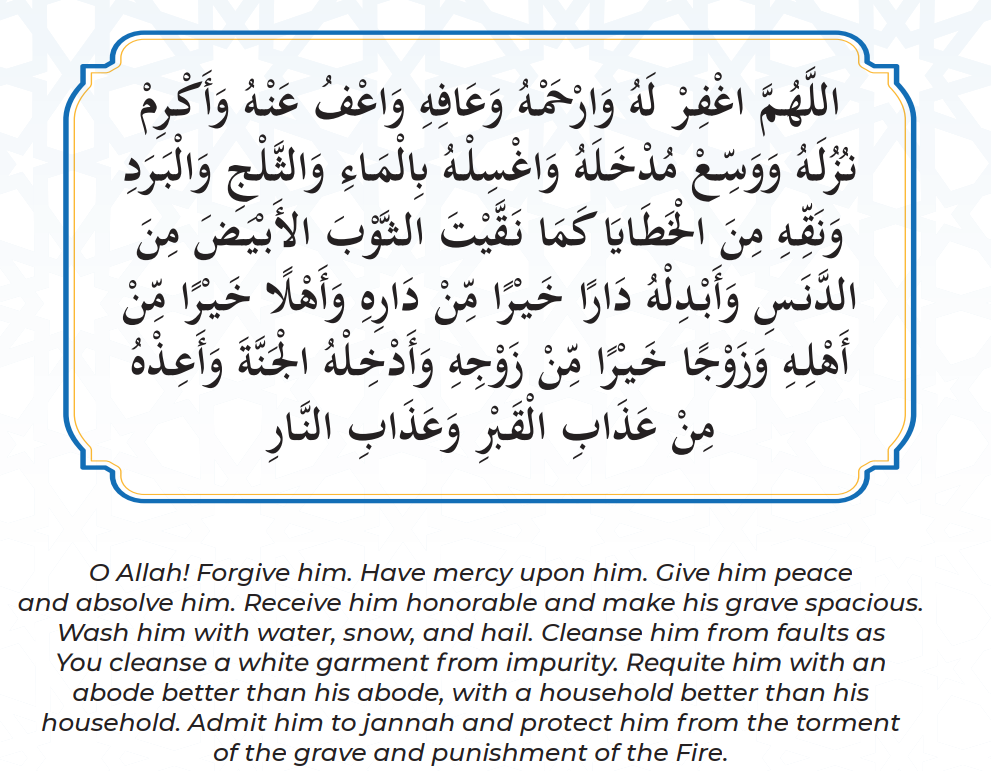
Thereafter the Takbeer should be said for the third time and the follow-ing Dua be recited for an adult male or female:
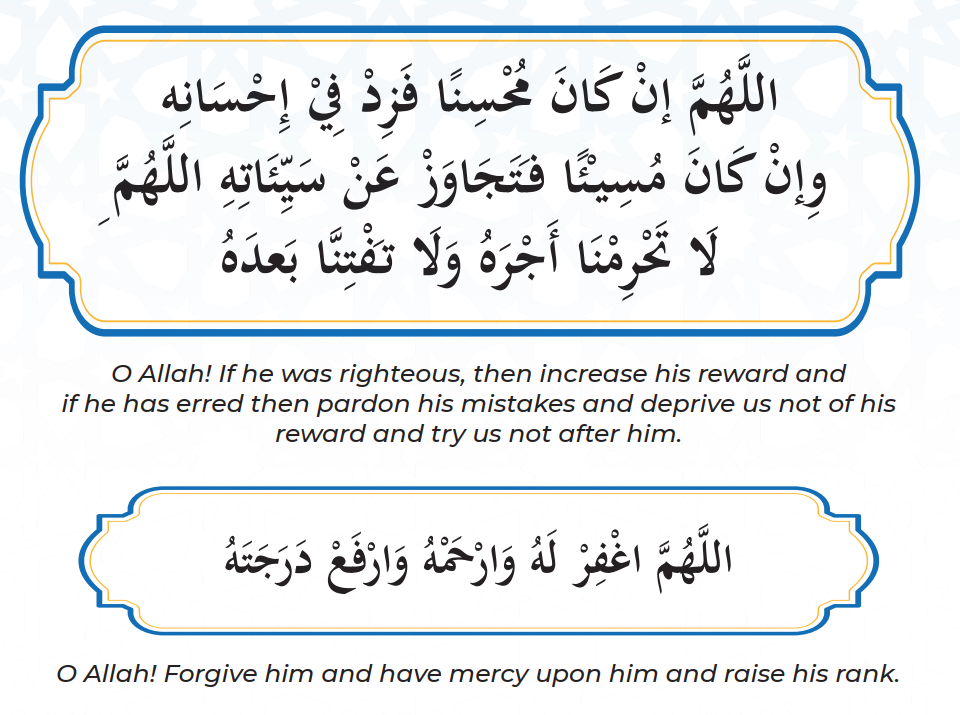
For a child who has not reached the age of puberty the following Dua should be recited after the third Takbeer.
Dua For Boy:
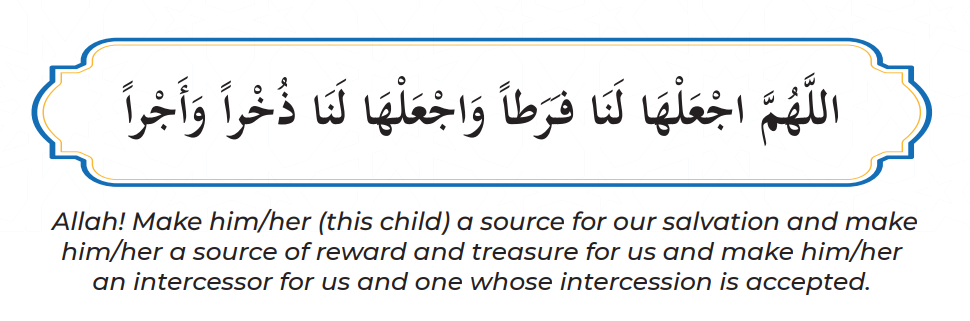
Dua For Girl:
Masnoon Duas that may be read in the funeral prayer:
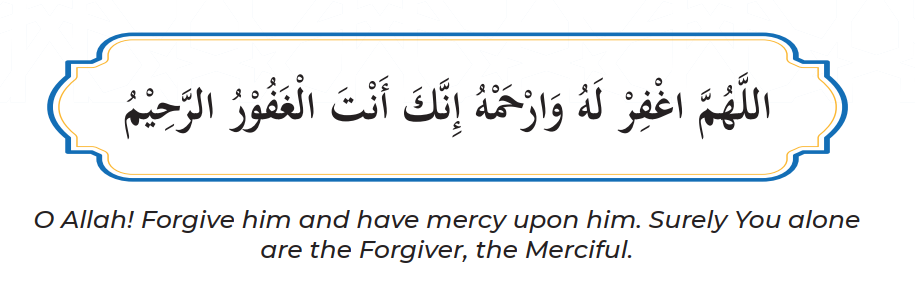
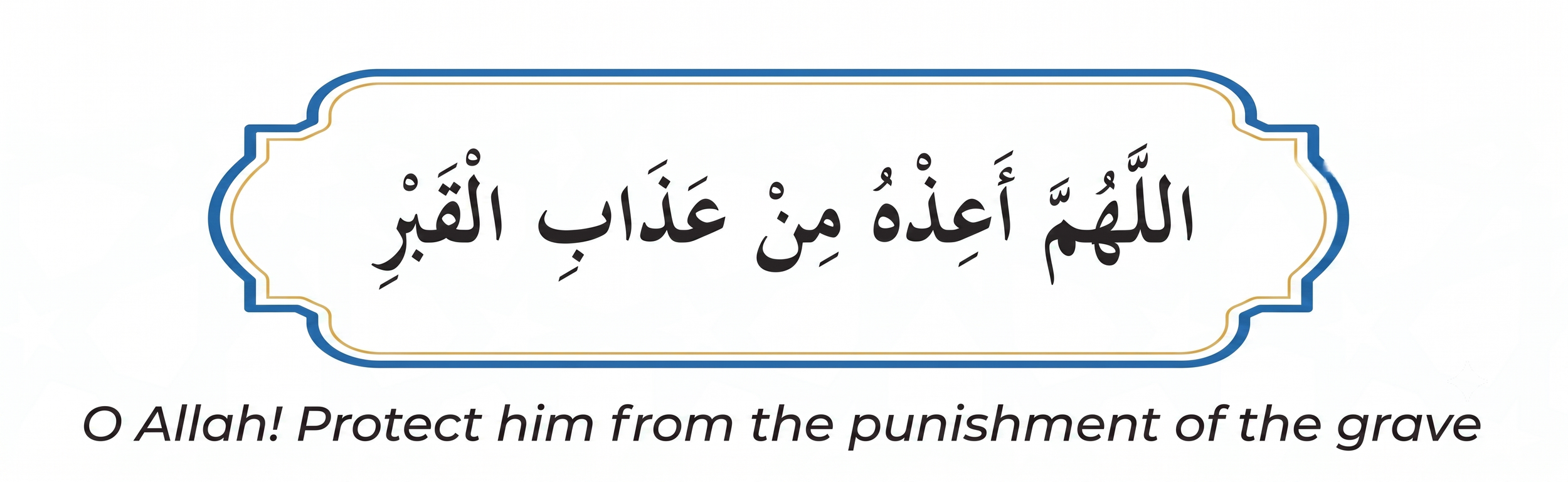
The Imam should say the fourth Takbeer and thereafter recite the Salaam aloud twice while turning his face first towards the right shoulder and then again towards the left. The Muqtadis (followers/worshippers) should follow by saying the Takbeer and Salaam softly.
LATE COMERS TO THE FUNERAL PRAYER
When a latecomer fears that if he engages himself in Wudu (ablution), he will miss the Funeral Prayers, only then is it permissible for him to make Tayammum (dry ablution) and join the Jama'at (congregation). This rule applies to the Funeral Prayers only.
Whosoever arrives for the Funeral Prayers after the Imam has recited one or more Takbeeraat should wait and join the Imam when he says the next Takbeer. After the Salaam he should complete the missed Takbeeraat by merely saying Allahu Akbar once for every Takbeer missed before his/her Salam. No Dua (supplication) should be read. If the Imam has completed the fourth Takbeer then too, the latecomer should join and complete all the missed Takbeeraat.
Once the funeral prayer is complete, the funeral prayer cannot be repeat-ed or offered again for any reason whatsoever.
IMPORTANT
It is only permissible for Mahram to see the face of a female deceased. The following relatives are considered to be Mahram: wife, mother, father, brother, sister, son, daughter, aunt, uncle, grandparents (paternal and maternal), and grandchildren.
It is permissible to recite the Holy Quran after the ghusl has been performed in the presence of the body of the deceased.
THE ISLAMIC METHOD OF BURIAL
Funeral should be arranged without delay. The Prophet(SA) has said: “If a person passes away, hasten him to his grave and do not keep him away. ” The funeral prayer should be arranged quickly, and the deceased should be buried in the nearest graveyard (cemetery).
To transport the body over long distances is undesirable. It is also mak-rooh (disliked) to delay the prayer and wait for latecomers to increase the Jama’at (congregation).
It is recommended for male relatives and the Muslim community to attend the burial service. It is advisable for women to visit the cemetery after the funeral.
After the funeral prayers are performed, the burial should take place as soon as possible. The deceased should be carried and placed at the Qiblah side of the grave. The head should be on the right side of the grave if one faces the Qiblah.
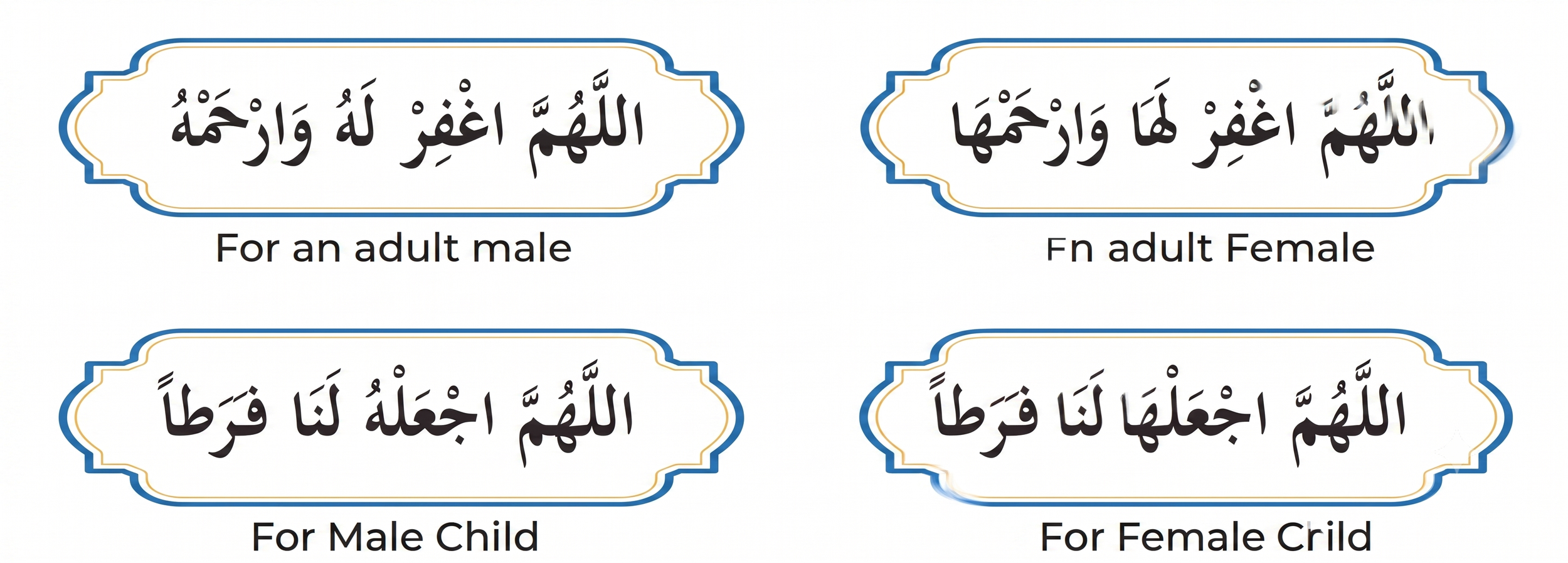
It is Mustahab (recommended) for those present to recite this Dua while the body is being lowered:
In the name of Allah and on the creed (of Islam), and on the religion and faith of Rasulullah (SA).
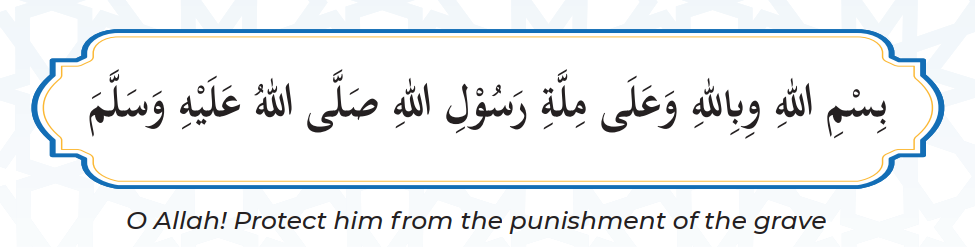
If someone is unable to recite the above duas, he or she may simply recite:
Before lowering the body into the grave, it is Sunnah to turn it onto its right side to face the Qiblah and ensure the strips of cloth tied at the head, side, chest, and leg side are untied.
HOW THE GRAVE SHOULD BE FILLED AND SHAPED
It is recommended (mustahab) to begin closing the recess or trench from the leg side for males and from the head side for females. All the remaining openings should be closed with mud or grass. The use of any fabric or blan-kets is unnecessary and wasteful. All those present should participate to fill the grave with at least three handfuls of soil.
When throwing the first handful of soil in the grave, recite:

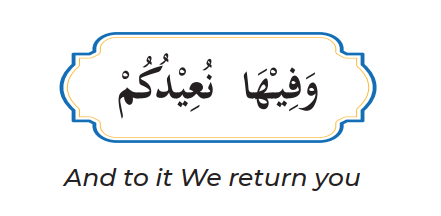
During the second handful:
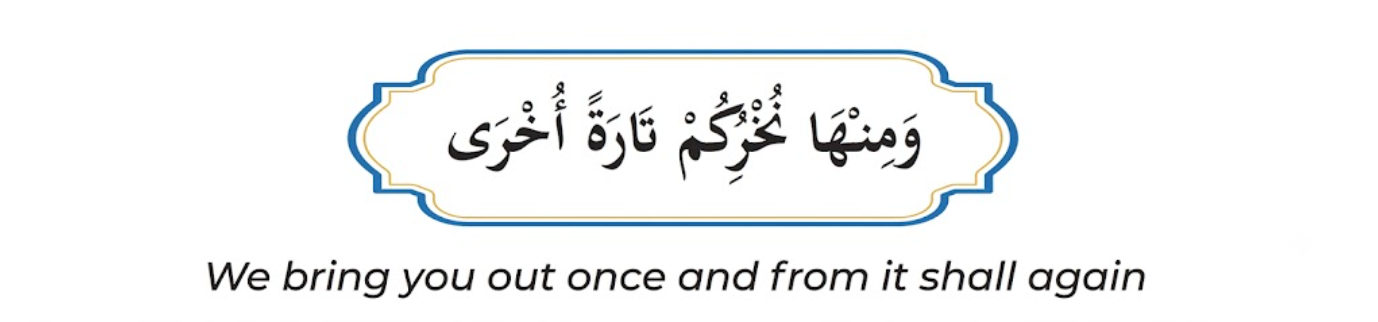
and at the time of the third handful:
All types of cemetery monuments, tombstones, inscriptions of the Holy Quran and enclosures on or around the grave are not recommended Structures on the grave have been emphatically denounced by the Prophet (SA)
It is Mustahab (recommended) to sprinkle water on the grave from the head to the leg side thrice after burial.
To recite the Holy Quran and make Dua for the deceased at his grave side after the grave is filled and shaped is also Mustahab (recommended).
It has been related by Hazrat Uthman (RA) that after the Prophet (SA) buried the dead, he paused and said, “Beseech forgiveness from Allah for your brother and make Dua for his steadfastness because he is going to be questioned now by the Munkar and Nakeer (angels).”
After the burial, the first Ruku of Surah Al-Baqarah should be read towards the head side of the grave.
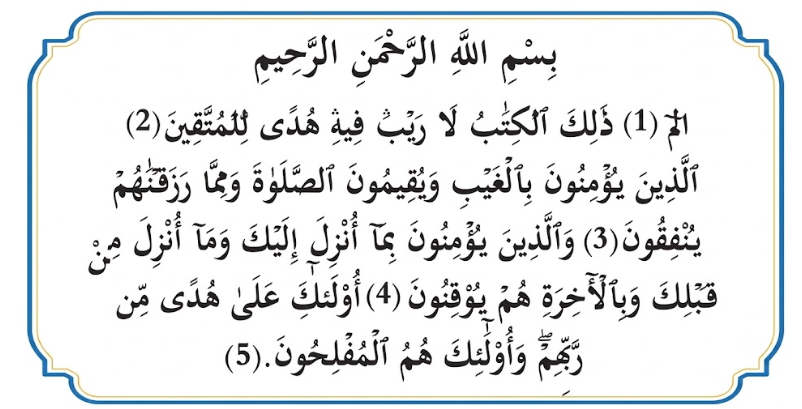
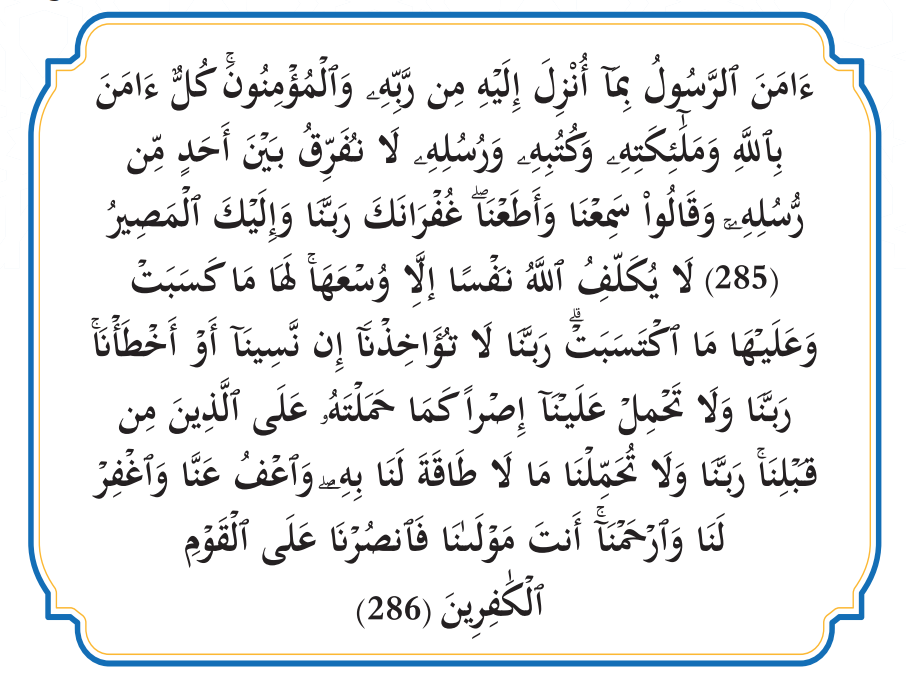
And the last Ruku of Surah Baqarah should be read towards the foot side of the grave.
Some other duas may also be recited.
THE EMBALMING PROCESS
Embalming, in most modern cultures, is the art and science of temporarily preserving human remains to forestall decomposition and to make them suitable for display at a funeral. The three goals of embalming are sanitization, presentation, and preservation (or restoration) of a dead body to achieve this effect.
During embalming, the body experiences the following
Rigor mortis (stiffness) is relieved by massage. (Rarely but sometimes, tendons or muscles are cut for a more natural pose if limbs are distorted by diseases like(arthritis.)
Massage cream is used on the face and hands to keep the skin soft and pliable.
Facial features are set by putting cotton in the nose, eye caps below the eyelids,and a mouth-former in the mouth (with cotton or gauze in the throat to absorb purging fluids). The mouth is then tied shut with wire or sutures. (Glue may be used on the eyelids or lips to keep them closed in an appropri-ate pose.) Facial hair is shaved if necessary.
Arterial embalming is begun by injecting embalming fluid into an artery while blood is drained from a nearby vein or the heart. The two gallons or so needed is usually a mixture of formaldehyde or another chemical and water. In the case of certain cancers, some diabetic conditions, or because of the drugs used prior to death (where body deterioration has already begun), a stronger or "waterless" solution is likely to be used for better body preservation. Chemicals are also injected by syringe into other areas of the body.
The second part of the embalming process is called cavity embalming. "Trocar", a long pointed metal tube attached to a suction hose, is inserted close to the navel. The embalmer uses it to puncture the stomach, bladder, large intestine, and lungs. Gas and body fluids are withdrawn before "cavity fluid" (a stronger mix) is injected into the torso.
The anus and vagina may be packed with cotton or gauze to prevent seepage if necessary (A close-fitting plastic garment may also be used.) Incisions and holes made in the body are sewn closed or filled with trocar "buttons." The body is washed again and dried.
Nails are manicured, any missing facial features are molded from wax, makeup is used on the face and hands, and head hair is styled. The body is dressed and placed in the casket (fingers are glued together if necessary).